Your portfolio is a sales tool, not a scrapbook
A strong screen printing portfolio isn’t just a place to show off past work — it’s one of your most important sales tools. Its job is to build trust fast and help the right clients say “Yep, this is the shop for us.”
That means the goal isn’t to show everything you’ve printed. It’s to show your range, consistency, and quality.
Quality > quantity. Always.
1. Start with your best work (and be ruthless)
Aim for 8–15 of your strongest prints. Each one should clearly show that you know your craft.
Look for prints that demonstrate:
-
Clean registration
-
Solid, opaque white underbases
-
Smooth, even ink deposits
-
Consistent, reliable curing
A good rule of thumb:
If you wouldn’t confidently sell that print today, don’t include it. One weak print can do more damage than ten great ones can fix.
2. Show variety — not chaos
Clients want to know you can handle different jobs, not just one specific look.
Include a mix of:
-
Light and dark garments
-
Plastisol, water-based, and specialty inks
-
Different garment types (tees, hoodies, totes, etc.)
You don’t need every style under the sun — just enough variety to show you’re capable, flexible, and experienced.
3. Use photos that actually sell the print
Great prints deserve great photos. Poor images can make even excellent work look sloppy.
Best practices:
-
Shoot in natural light or with soft box lighting
-
Use clean, neutral backgrounds
-
Include close-ups that show ink texture and detail
Blurry, dark, or cluttered photos hurt more than they help. If a photo doesn’t clearly show the quality of the print, don’t use it.
4. Add context — don’t just post images
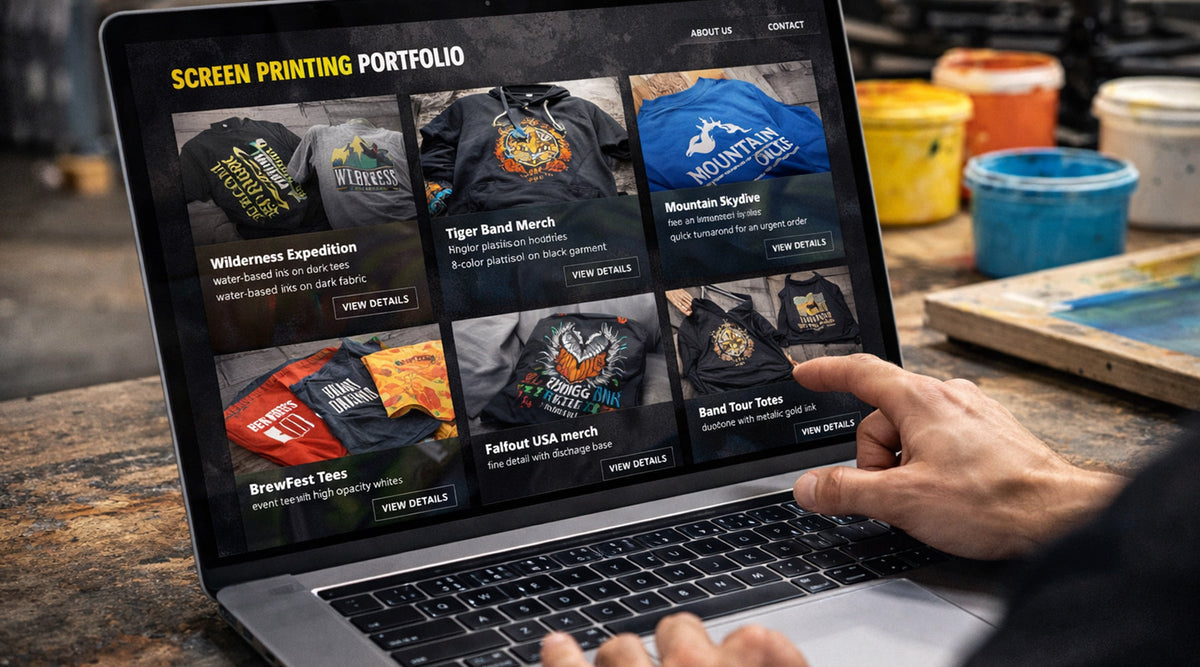
A portfolio shouldn’t feel like a silent gallery. Every print should tell a quick story.
For each piece, include:
-
Who the client was (brand, event, business, etc.)
-
The challenge (dark garment, fine detail, tight deadline)
-
The solution (ink choice, technique, process used)
This shows experience, problem-solving, and the size or complexity of jobs you can handle — not just the final result.
5. Make your strengths obvious
Don’t make clients guess what you’re good at. Spell it out so the right customers self-select you.
Ask yourself:
-
Do you specialize in fast turnarounds?
-
High-opacity whites?
-
Specialty or niche inks?
-
Small-batch or short-run orders?
Whatever you do best, highlight it clearly throughout your portfolio.
6. Make it easy to contact you
If someone loves your work but can’t figure out how to reach you, they’ll move on.
Always include:
-
Clear contact info
-
A link to your website or order form
-
A strong call to action (DMs, email, quote request)
-
Links to your social media accounts
No friction. No hunting. Just clear next steps.
7. Keep it fresh
An outdated portfolio makes a shop look inactive — even if you’re busy every day.
Treat your portfolio like shelves in a print shop:
-
Rotate in recent work
-
Remove older or weaker prints
-
Showcase what you’re producing now
A fresh, well-curated portfolio builds confidence instantly.